This Math Teacher: A Designer's Review for Real Embroidery
As someone who spends more time staring at stitch maps than most people spend looking at their own families, I approach every new digital embroidery file with a healthy dose of skepticism. We have all been there: you buy a cute graphic, load it into your software, and realize the satin columns are too wide for the lettering or the fill density is going to turn your soft cotton into a cardboard coaster. That is why I was particularly interested in putting This Math Teacher under the microscope. This isn't just about whether the design looks good on a screen; it is about whether it survives the journey from a vector path to a tangible, washable, sellable handmade product.
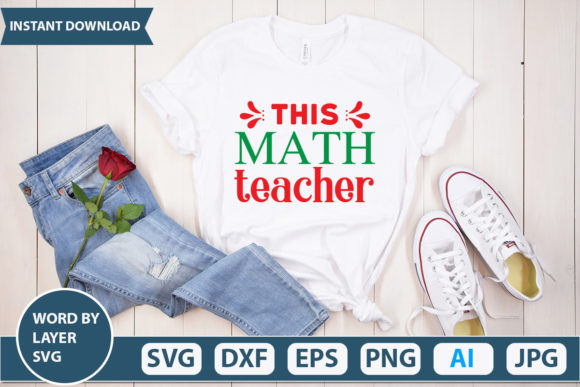
My first impression of This Math Teacher was one of clean, academic charm. The layout feels intentional, balancing the whimsical nature of teaching with the precision of mathematics. Visually, it carries a mood that is both professional and approachable, making it an ideal candidate for custom apparel aimed at educators. Whether you are creating a gift for a favorite instructor or stocking inventory for a boutique catering to school staff, the visual personality here hits the right note. It avoids the overly childish clip-art look that often plagues this niche, opting instead for a design that respects the intelligence of the wearer while celebrating their profession.
Putting the Design to the Test: The End-of-Year Gift Scenario
To truly evaluate this design, I imagined a real-world scenario that many of us face every spring: the rush to create personalized end-of-year gifts. Picture a parent wanting a high-quality sweatshirt embroidery piece for their child's teacher, or perhaps a small shop owner creating a limited run of tote bags for a school fundraiser. In this context, This Math Teacher shines because of its versatility. The design translates well across different mediums. I could easily see this working as a chest logo on a heavy blend crewneck, where the structure of the fabric supports the stitching beautifully.
However, the true test for any designer is how the file behaves when you start manipulating it. Since the product description indicates you receive layer-by-layer SVG files along with an Adobe Illustrator source file, the potential for customization is significant. For an Etsy seller or creative entrepreneur, this is gold. You aren't stuck with a static image. You can separate elements to create an applique design version, swapping out a solid fill for a textured fabric patch, which adds tremendous value to the finished product. If you are selling design assets or physical goods, having that AI file means you can tweak the scale or rearrange components to fit specific hoop constraints without losing quality.
Navigating Fabric Textures and Stitch Density
When discussing machine embroidery design, we have to talk about the interaction between thread and fabric. This Math Teacher appears to have a balanced composition, but like any design featuring text or mathematical symbols, attention to detail is paramount. If you are stitching this onto a tote bag design made of canvas, the fabric texture will hold up well against denser stitch areas. However, if you are attempting this on a thin, stretchy jersey for a baby embroidery project, you need to be cautious.
Small details, such as the equals signs, plus symbols, or specific numbers within the design, require precise tension settings. On dark fabrics, you must ensure your thread colors provide enough contrast so the math elements don't get lost in the background. I always recommend running a test stitch-out on scrap fabric that matches your final material. This allows you to check the stitch density. If the design feels too stiff after stitching, you may need to adjust your fill patterns or reduce the density in your digitizing software before committing to the final garment. Remember, a comfortable teacher wants a comfortable shirt.
Curved surfaces present another challenge. If you plan to use this for holiday embroidery on a cap or a structured hat, the curvature can distort linear elements. Mathematical lines need to remain straight to look authentic. In these cases, using a sturdy cut-away stabilizer is non-negotiable to prevent puckering and maintain the integrity of the geometric shapes. For flat items like pillow covers or kitchen towels, a tear-away stabilizer might suffice, but always consider how often the item will be washed. Frequent washing demands a stable foundation, or else those crisp lines will blur over time.
Commercial Viability and Brand Consistency
For those running a craft business, the commercial viability of a design is just as important as its aesthetic appeal. This Math Teacher has the kind of timeless appeal that doesn't scream "trendy" in a way that will be outdated by next semester. This longevity is crucial for building a catalog of small shop products that sell year after year. When a customer sees a clean, well-executed design, it builds trust. It signals that the maker cares about quality, which directly influences buyer engagement and repeat business.
Using this design in printable mockups for your online store is also a smart move. Because the lines are distinct, it photographs well, allowing potential customers to clearly see the detail even in thumbnail images. This clarity helps in marketing personalized gift options, where buyers want to visualize exactly what they are purchasing. Whether you are offering it as a standalone embroidered patch or as part of a larger collection of educator-themed goods, the design holds its own visually.
Final Thoughts for the Practical Maker
In the world of Crafts and Graphics, finding a file that bridges the gap between digital convenience and physical durability is rare. This Math Teacher offers a solid foundation for a variety of projects, from commercial embroidery runs to one-off custom orders. However, the responsibility ultimately lies with the maker to adapt the file to their specific machine and material constraints.
Before you start stitching, take a moment to review the licensing terms provided with your download. While the inclusion of AI and SVG files suggests great flexibility for editing, you must confirm whether the license permits unlimited sales of finished physical items or if there are restrictions on reselling the digital files themselves. Never assume; always read the fine print to protect your business.
Additionally, do not skip the step of checking the hoop size requirements. Even if the design looks small on your monitor, the stitch count might require a larger frame to accommodate the jump stitches or trim points effectively. If you are working with very small lettering within the math equations, consider simplifying those areas or increasing their size slightly to ensure the satin stitch or running stitch elements do not merge together during the sewing process.
Ultimately, This Math Teacher is a promising asset for your library. It respects the subject matter and offers enough structural integrity to look professional when executed with care. By paying attention to fabric choice, stabilizer selection, and thread contrast, you can transform this digital file into a cherished keepsake that honors the hard work of educators everywhere. Happy stitching, and may your tension always be perfect.